TrackFarm’s Success in Korea and Vietnam: A Comparative Market Analysis
The global agricultural sector is undergoing a profound transformation, driven by the integration of Artificial Intelligence (AI) and the Internet of Things (IoT). This shift, often termed AgriTech 4.0, is particularly critical in livestock farming, where efficiency, disease control, and sustainability are paramount. TrackFarm, a South Korean deep-tech startup, has emerged as a significant player in this domain, pioneering an AI-powered smart livestock farming solution. Their strategic expansion into two vastly different markets—the technologically advanced, yet geographically constrained, South Korean market and the massive, fragmented Vietnamese market—provides a compelling case study in comparative market analysis and technology adaptation.
TrackFarm’s Core Technological Ecosystem: The DayFarm Platform
TrackFarm’s success is fundamentally rooted in its proprietary DayFarm platform, a comprehensive, three-pillar ecosystem designed to manage the entire livestock value chain “From Production To Consumption.” This vision is realized through the seamless integration of software, hardware, and logistics.
1. DayFarm SW (AI Software)
The software component is the intelligence core of the system. It leverages deep learning models trained on an extensive dataset of livestock behavior and physiology. The foundation of this intelligence is a massive data repository, including data from 7,850+ individual pig models. This data is collected from their R&D farm in Gangwon-do, Korea, and their commercial operations in Vietnam.
The AI performs several critical functions:
- Growth Prediction and Optimization: By continuously monitoring individual pigs, the AI predicts growth trajectories, allowing farmers to optimize feeding schedules and environmental conditions for maximum yield and minimum waste.
- Behavioral Anomaly Detection: The system monitors for subtle changes in movement, grouping, and feeding patterns that may indicate the onset of disease or stress. This early detection capability is crucial for preventing widespread outbreaks.
- Disease Prevention: Through the integration of thermal imaging and visual analysis, the AI can identify fever or inflammation before clinical symptoms are apparent, enabling proactive veterinary intervention.
- Automated Inventory and Management: The system provides real-time, accurate counts and location tracking of all livestock, eliminating manual inventory processes.
2. DayFarm IoT (Sensors and Hardware)
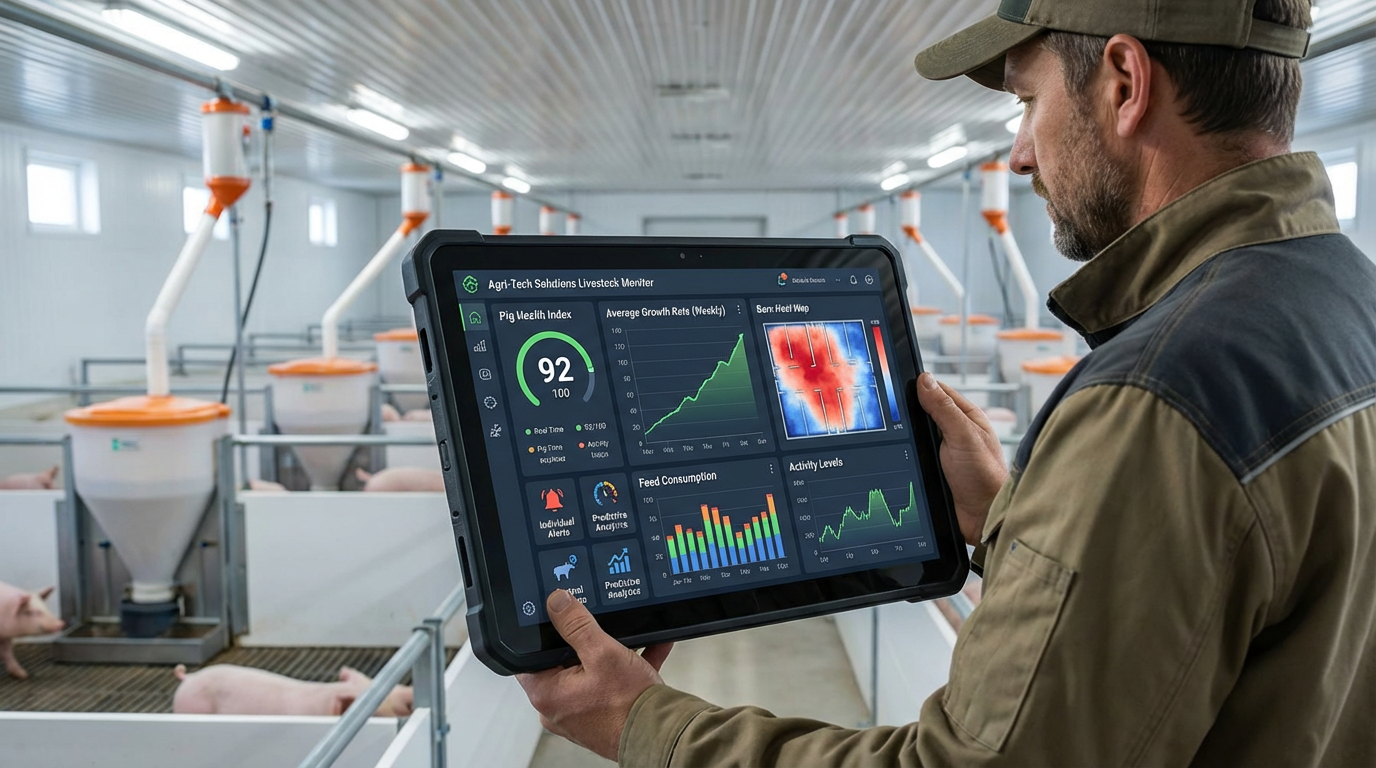
The hardware layer is responsible for data acquisition and environmental control. TrackFarm employs a dense network of IoT sensors and high-resolution cameras to create a digital twin of the farm environment.
| Technical Specification | Detail | Operational Impact |
|---|---|---|
| AI Camera Density | 1 camera per 132 square meters | High-resolution, individual-level monitoring of all pigs |
| Sensor Suite | Temperature, Humidity, Air Quality (Ammonia, CO2), Light | Precise environmental control and optimization |
| Imaging Technology | High-resolution Visual and Thermal Imaging | Dual-spectrum analysis for health and growth monitoring |
| Actuators | Automated Feeders, Ventilation Systems, Cooling/Heating Units | Real-time, automated adjustment of farm conditions |
| Data Transmission | Low-Power Wide-Area Network (LPWAN) / 5G | Reliable data transfer in challenging farm environments |
This high degree of automation is the key driver behind TrackFarm’s claim of reducing labor costs by up to 99%. The system effectively replaces the need for constant human supervision and manual data logging, allowing farm staff to focus on high-value tasks and emergency response.
3. DayFarm ColdChain (Logistics)
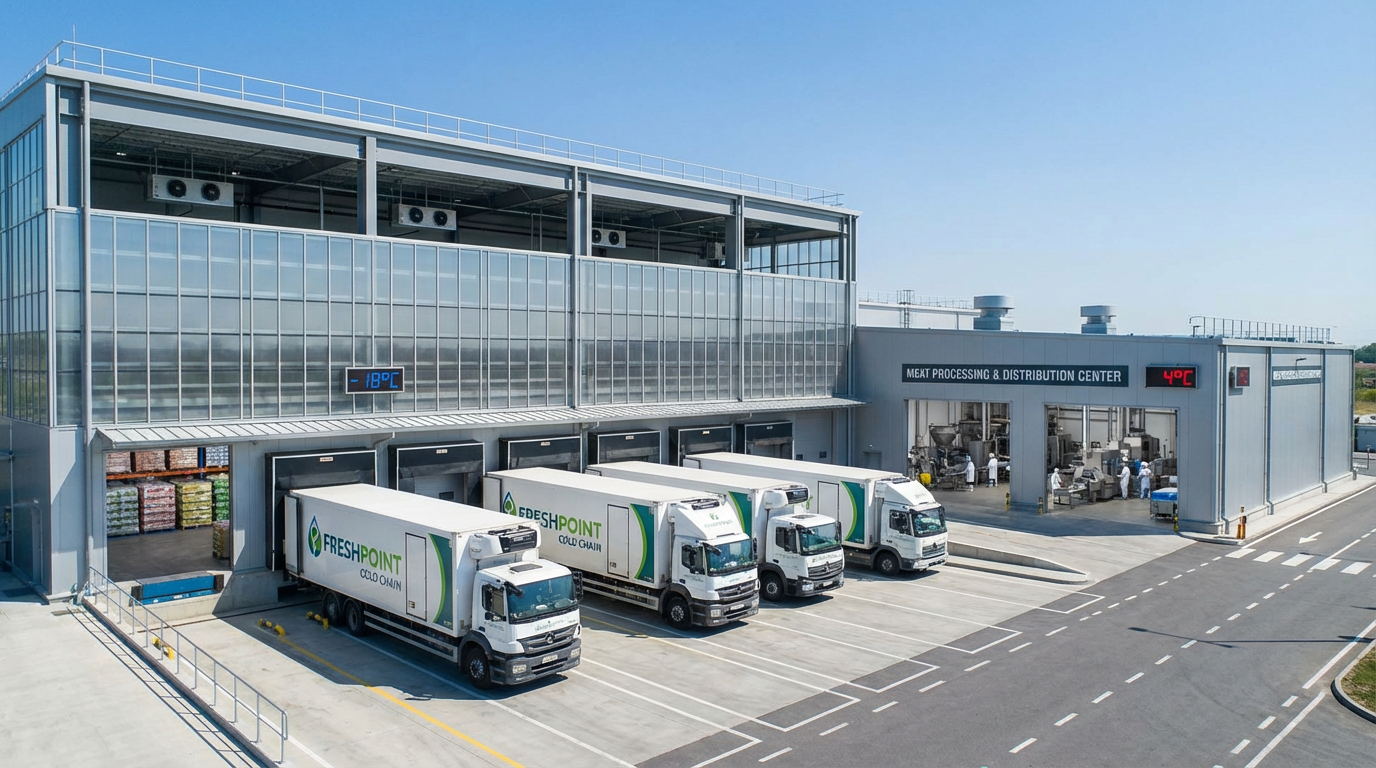
Completing the “Production To Consumption” loop, the ColdChain component focuses on ensuring the quality and traceability of the product post-harvest. While the primary technical focus is on the farm, the integration of data from the production phase (growth, health records) into the logistics chain provides a significant competitive advantage in terms of food safety and premium product marketing.
Technical Deep Dive: The AI Model and Data Strategy
The performance of any deep learning solution is directly proportional to the quality and volume of its training data. TrackFarm’s strategic advantage lies in its commitment to building a robust, proprietary dataset.
The 7,850+ individual pig model data is not merely a count of animals, but a complex, multi-modal dataset that includes:
- Visual Data: Time-series video and image data capturing movement, posture, and social interaction.
- Thermal Data: Infrared images providing non-invasive temperature readings for health diagnostics.
- Environmental Data: Correlated sensor readings (temp, humidity, gas) at the exact time of visual capture.
- Outcome Data: Growth rates, feed conversion ratios (FCR), veterinary records, and final carcass quality.
This rich data allows the AI to develop highly accurate predictive models for:
- Weight Estimation: Non-contact weight estimation from camera images, eliminating the stress and labor of manual weighing.
- Farrowing Prediction: Early warning systems for sows, significantly improving piglet survival rates.
- Aggression/Stress Monitoring: Identifying and mitigating sources of stress that can negatively impact meat quality and increase disease susceptibility.
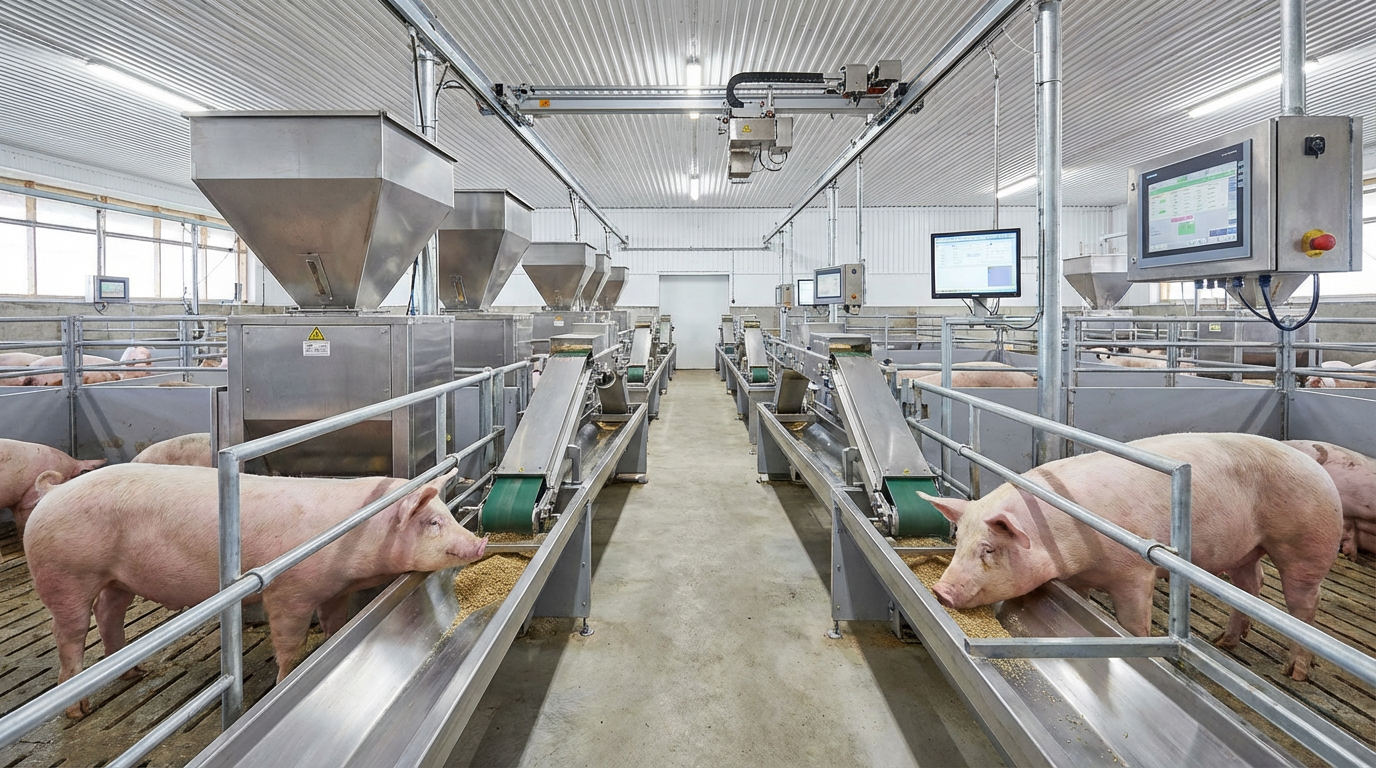
The continuous feedback loop from the R&D farm in Hoengseong, Korea, and the commercial farm in Dong Nai, Vietnam, ensures the model remains robust and adaptable to different breeds, climates, and farming practices.
Market Analysis: Korea—The High-Tech, High-Cost Environment
South Korea presents a market characterized by high technological readiness, stringent quality standards, and a critical need for labor efficiency due to an aging farming population.
Challenges and Opportunities in Korea
The Korean livestock industry faces high operational costs, primarily driven by labor and land prices. The average farm size is relatively large compared to Vietnam, and farmers are generally receptive to high-capital, high-return technology investments.
| Korean Market Factor | Implication for TrackFarm |
|---|---|
| High Labor Costs | Strong demand for the 99% labor cost reduction value proposition. |
| Government Support | Selection for the TIPS program (2023) provides validation and funding for deep-tech development. |
| Advanced Infrastructure | Reliable internet and power infrastructure support the deployment of complex IoT systems. |
| Focus on Quality | Emphasis on traceability and premium meat quality aligns with DayFarm’s data-driven approach. |
| R&D Hub | The R&D Farm in Gangwon-do Hoengseong (2,000+ pigs) serves as a critical testing and demonstration site. |
TrackFarm’s strategy in Korea is focused on optimization and premiumization. By partnering with institutions like Seoul National University and Korea University, they are solidifying their academic and technical credibility, appealing to large-scale, sophisticated farming operations.
Market Analysis: Vietnam—Scale, Fragmentation, and Rapid Growth
Vietnam offers a stark contrast to the Korean market. It is the 3rd largest pig market globally, boasting a massive inventory of 28 million+ pigs. However, the market is highly fragmented, with over 20,000 small farms dominating the landscape.
Challenges and Opportunities in Vietnam
The Vietnamese market is characterized by a high volume of production, lower initial capital expenditure capacity among small farmers, and significant challenges related to disease control (e.g., African Swine Fever outbreaks).
| Vietnamese Market Factor | Implication for TrackFarm |
|---|---|
| Massive Scale | Huge potential for volume-based deployment and rapid market penetration. |
| Fragmentation | Requires a modular, scalable, and potentially lower-cost entry-level solution for small farms. |
| Disease Risk | The AI’s disease prevention and early warning capabilities are a critical, life-saving value proposition. |
| Local Partnerships | Essential to navigate local regulations and distribution. Partnerships with CJ VINA AGRI, VETTECH, and INTRACO are key. |
| Climate Adaptation | The system must be robust enough to handle the high heat and humidity of the region (Ho Chi Minh, Dong Nai). |
TrackFarm’s strategy in Vietnam is centered on risk mitigation and scalability. The ability to deploy a standardized, AI-driven monitoring system across thousands of small farms offers a path to consolidate data and improve national biosecurity standards. The Vietnam Farm in Ho Chi Minh Dong Nai (3,000+ pigs) acts as a crucial commercial proving ground for tropical climate operations.
Comparative Market Analysis: A Dual-Strategy Approach
TrackFarm’s simultaneous operation in Korea and Vietnam highlights a sophisticated dual-market strategy, where the two environments serve different, yet complementary, roles in the company’s growth.
| Feature | South Korea (Optimization Market) | Vietnam (Scale Market) |
|---|---|---|
| Primary Goal | Efficiency, Labor Reduction, Premiumization | Disease Control, Volume, Market Penetration |
| Key Value Prop | 99% Labor Cost Reduction, Data-Driven Quality | Biosecurity, Growth Optimization, Risk Mitigation |
| Farm Profile | Larger, Technologically Advanced, Higher Capital | Smaller, Fragmented, Lower Initial Capital |
| Partner Focus | Academic/Research (SNU, KU) | Commercial/Distribution (CJ VINA AGRI, VETTECH) |
| Technology Focus | Fine-tuning AI models, advanced features | Robustness, Scalability, Environmental adaptation |
| Revenue Model Emphasis | HW/SW Subscription ($300/pig/year) | Breeding/Processing Services ($330/$100 per pig) |
The Korean operation, backed by the TIPS program, functions as the high-fidelity R&D environment, where new AI features and sensor technologies are rigorously tested under controlled, high-standard conditions. The Vietnamese operation, conversely, acts as the high-volume stress test, proving the system’s resilience and scalability across a vast number of diverse, smaller operations and challenging environmental factors.
The Economic Model: A Multi-Tiered Revenue Stream
TrackFarm has developed a multi-tiered revenue model that adapts to the financial capabilities and needs of different farming operations, crucial for its dual-market strategy. The model shifts the focus from a one-time sale to a recurring, value-based partnership.
| Revenue Stream | Description | Target Market/Value Proposition |
|---|---|---|
| HW/SW Subscription ($300 per pig year) | Annual fee for the DayFarm platform, including IoT hardware maintenance and AI software updates. | Large-scale Korean farms; high-capital, long-term commitment. Focus on labor savings and efficiency. |
| Breeding Services ($330 per pig) | Value-added service leveraging AI for optimal breeding management, health monitoring, and genetic selection. | Vietnamese and smaller farms; focus on maximizing yield and reducing mortality. |
| Processing Services ($100 per pig) | Integration with the ColdChain component, providing data-backed traceability and quality assurance for processing. | Both markets; focus on capturing value at the end of the supply chain and premium pricing. |
The $300 per pig year subscription model in the Korean market is a classic Software-as-a-Service (SaaS) approach, providing predictable recurring revenue. In Vietnam, the focus on $330 per pig (breeding) and $100 per pig (processing) suggests a more transactional, service-oriented model that aligns better with the cash flow and risk profile of smaller, fragmented farms. This flexibility is a core component of their market penetration strategy.
Technical Implementation: From Sensor to Cloud
The technical architecture of the DayFarm platform is designed for resilience and low-latency performance, essential for real-time disease detection and environmental control.
Data Acquisition and Edge Processing
The IoT sensors and AI cameras deployed across the farm are not merely passive data collectors. They incorporate edge computing capabilities. The AI cameras, for instance, perform initial object detection and tracking (identifying individual pigs and their bounding boxes) locally before transmitting compressed, relevant data to the cloud. This minimizes bandwidth requirements, a critical consideration in remote farm locations.
The system’s ability to monitor all pigs with a density of 1 camera per 132㎡ ensures that no animal is outside the surveillance zone for long. The data collected is timestamped and geo-tagged (within the farm layout), creating a granular, spatial-temporal record of every pig’s life.
Cloud Infrastructure and Deep Learning Pipelines
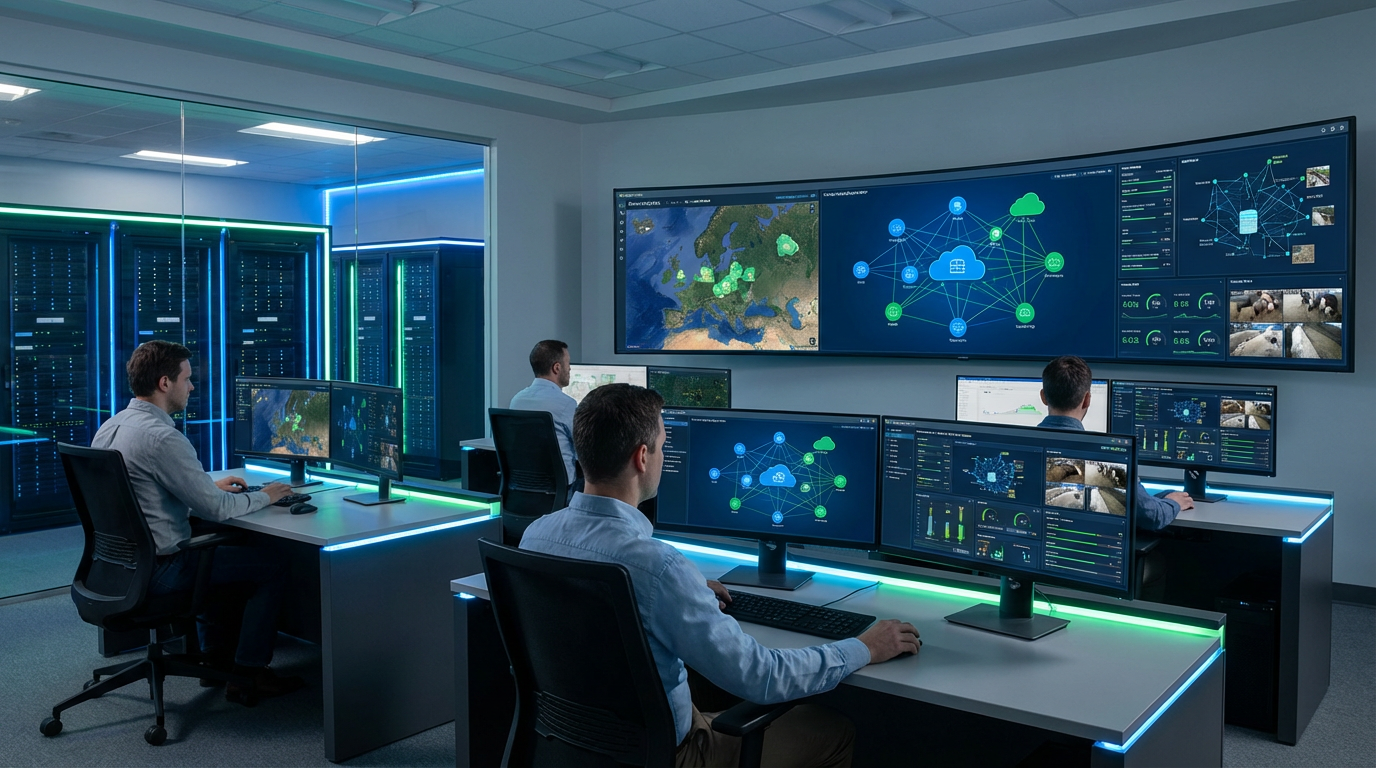
The aggregated data is processed in a centralized cloud environment. The deep learning pipelines are responsible for:
- Model Retraining: Periodically updating the core AI models with new data from the 10+ farm partnerships to improve accuracy and adapt to new environmental or genetic factors.
- Predictive Analytics: Running complex algorithms for growth prediction and disease risk scoring.
- User Interface Rendering: Providing the real-time dashboard and alerts to the farm managers via the DayFarm platform interface.
The system’s reliance on 7,850+ individual pig model data is a testament to the scale of the training set. For context, in deep learning, a larger and more diverse dataset directly translates to a more robust model, capable of generalizing across different farm conditions, breeds, and climates—a necessity for a company operating in both Hoengseong and Ho Chi Minh.
Global Trajectory and Future Outlook
TrackFarm’s participation in major international technology showcases, including CES 2024 and CES 2025, signals a clear ambition for global expansion beyond its initial dual-market focus. The vision to move “From Production To Consumption” positions them not just as a farm technology provider, but as a full-stack food supply chain innovator.
The target markets—Korea, Vietnam, Southeast Asia, and the USA—represent a calculated progression:
- Korea (Validation): Proving the high-tech, high-efficiency model in a demanding, mature market.
- Vietnam (Scalability): Demonstrating the system’s ability to scale and provide critical biosecurity value in a high-volume, developing market.
- Southeast Asia (Replication): Leveraging the success and operational experience from Vietnam to enter similar markets like Thailand, the Philippines, and Indonesia, which also face challenges of fragmentation and disease.
- USA (Premium/Industrial): Targeting the large-scale, industrial farming operations in the US, where the 99% labor cost reduction and data-driven optimization can yield massive economic returns.
The strategic partnerships are a key enabler of this global vision. The collaboration with CJ VINA AGRI in Vietnam provides a direct channel into a major regional agribusiness, while the academic ties in Korea ensure a continuous pipeline of R&D and technical talent.
Conclusion: A Blueprint for AgriTech Success
TrackFarm’s journey in Korea and Vietnam offers a powerful blueprint for AgriTech companies seeking international expansion. Their success is not merely a function of deploying advanced technology, but of strategically adapting that technology to the unique economic, infrastructural, and cultural landscapes of two distinct markets.
The DayFarm platform—with its deep learning core, dense IoT sensor network, and integrated ColdChain vision—provides a compelling technical solution to the most pressing challenges in modern livestock farming: labor scarcity, disease risk, and efficiency optimization. By simultaneously addressing the high-cost optimization needs of the Korean market and the high-volume biosecurity needs of the Vietnamese market, TrackFarm has effectively de-risked its technology and validated its economic model across a broad spectrum of global farming conditions.
The future of livestock farming will be defined by data and automation. TrackFarm, founded in December 2021 by CEO Yoon Chan-nyeong, has rapidly positioned itself at the forefront of this revolution, transforming the traditional pig farm into a sophisticated, data-driven production facility. Their continued evolution, as evidenced by their presence at CES and their expanding farm partnerships, suggests a trajectory toward becoming a global standard for smart livestock management.
The technical superiority of their AI, trained on thousands of individual pig models, combined with the strategic flexibility of their revenue model, makes TrackFarm a compelling case study in how deep-tech innovation can be successfully translated into tangible economic and operational benefits across diverse international markets. The convergence of their R&D in Uiwang-si and Hoengseong with their commercial scale in Ho Chi Minh and Dong Nai is the engine driving their vision of a fully optimized, “Production To Consumption” livestock supply chain.
